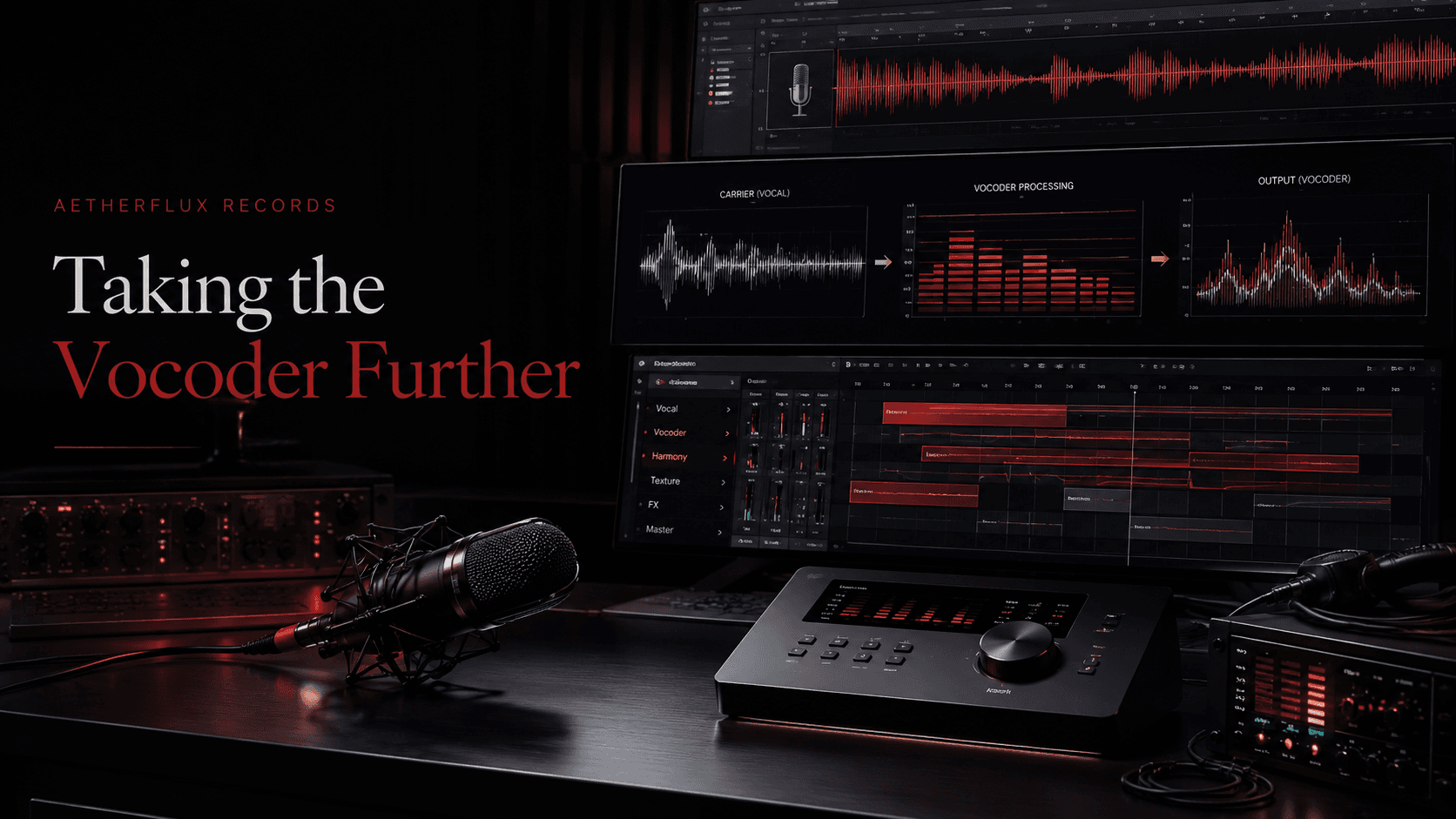
At Aetherflux Records, vocal production does not begin with a preset.
It begins with a raw studio session.
Before the vocal ever reaches a traditional DAW, CARMINE records inside Aetherflux’s own studio software, designed to speed up the vocal-take process and make recording more direct. The purpose is simple: capture ideas faster, move through takes more efficiently, and allow the artist to stay in the creative zone without being slowed down by the usual friction of a recording session.
That matters because speed changes the way music is made.
When the recording process is too slow, the emotion can disappear before the take is captured. A melody can lose its feeling. A phrase can become overthought. The Aetherflux recording workflow is built to keep the session moving so CARMINE can sing, test ideas, stack takes, and build records faster.
From there, the raw studio recording is processed through Aetherflux’s custom vocoder system.
This is where the vocal begins to take on its identity.
The vocoder is not used as a generic robot effect. It is not just a layer thrown on top of a vocal after the fact. At Aetherflux, the vocoder is part of the core processing chain. It takes the raw studio session and shapes it with tone, movement, texture, and controlled imperfection. It gives the vocal a processed character while still allowing the original performance to remain the foundation.
The vocoder has a long history in popular music.
Artists and producers have used vocal processing for decades to create sounds that felt futuristic, emotional, robotic, soulful, strange, or completely new. Kraftwerk helped make electronic vocal processing feel like part of a full artistic identity. Herbie Hancock used vocoder technology in a jazz-funk context, showing how processed vocals could live inside serious musicianship. Roger Troutman and Zapp made talk box and processed vocal textures central to funk and R&B. Daft Punk turned vocoder-driven vocals into a signature part of their electronic sound. Imogen Heap used vocal harmonizer processing on “Hide and Seek” to create one of the most recognizable processed-vocal records of the 2000s. Kanye West later helped push processed vocals into a more emotionally exposed hip-hop space, using Auto-Tune and vocal effects on *808s & Heartbreak* to make heartbreak, isolation, and vulnerability sound synthetic but human at the same time.
Those artists proved something important: vocal technology can become identity.
But Aetherflux is not trying to repeat the past.
The goal is not to sound like Kraftwerk, Daft Punk, Roger Troutman, Herbie Hancock, Imogen Heap, Kanye West, or any other artist associated with processed vocals. Their work shows what vocal technology made possible in different eras. CARMINE’s process is about what happens when an artist can engineer the tools around his own voice instead of only using the tools that already exist.
That is one of the biggest differences between CARMINE’s process and the process used by most artists.
Most musicians have to rely on publicly available tools. They record into standard software, open the same plugins everyone else has access to, scroll through presets, and try to make something original inside a system built for the entire market.
CARMINE approaches the process differently.
As a senior engineer, he is able to help build and shape the tools used in his own music. That means the vocal chain is not limited to what is commercially available. If the sound needs a specific behavior, a different workflow, or a more personalized processing stage, the tool can be engineered around the music instead of forcing the music to fit the tool.
That is what sets the Aetherflux process apart.
The studio software is built to make recording faster. The vocoder is built to process the raw vocal session with a sound that belongs to the artist. Then, after that stage, the vocal can move into the DAW of choice for the final production chain.
That final stage is where traditional engineering still plays an important role.
Once the vocoder-processed vocal is inside the DAW, the session can be refined with autotune, pitch correction, compression, vocal tuning, and additional effects when needed. Flanger, phaser, delay, reverb, and other movement-based effects may be added depending on the record. Some songs need more polish. Some need more grit. Some need a darker vocal texture. Some need the processing pulled back so the raw tone cuts through.
The point is control.
Aetherflux does not treat vocal production as one plugin or one trick. It is a full chain: recording, processing, shaping, correcting, tuning, and finishing. Each stage has a purpose. Each stage affects the emotion, speed, and identity of the record.
The vocoder sits at the center of that process because it transforms the raw session before the final mix begins.
That is different from using a vocoder only as a final effect. By processing the raw studio recording earlier in the workflow, the vocal becomes part of the production architecture. The texture is not something added later to decorate the track. It becomes part of how the song is built.
This is why CARMINE’s technical background matters.
He is not only an artist looking for a sound. He is an engineer capable of building the system that helps create that sound. That gives him a level of independence most musicians do not have. Instead of waiting for a public plugin to offer the right feature, he can work from the engineering side and shape the process around the record.
That does not remove the need for taste.
It increases it.
The more control an artist has, the more important every decision becomes. Too much tuning can erase the feeling. Too much vocoder can flatten the performance. Too much compression can remove the air. Too many effects can bury the vocal instead of elevating it. The process only works when the engineering serves the record.
At Aetherflux, the goal is not to make the voice sound artificial for the sake of it.
The goal is to create a vocal identity that feels engineered, controlled, and personal.
That identity begins with CARMINE recording through Aetherflux’s studio software. It moves through the custom vocoder system. It continues inside the DAW with tuning, correction, compression, and final effects. By the time the vocal reaches the finished record, it has passed through a process that is both creative and technical.
This is where Aetherflux takes vocoders to a new level.
Not by treating them as a novelty.
Not by copying the same sounds already available to everyone.
But by making the vocoder part of a larger engineered workflow designed around one artist, one voice, and one sound.
The vocoder has already shaped music history.
For CARMINE, it is now part of a private system built for the next phase of his sound.
— Aetherflux Records